Kavish Raj Singh: the longer story
The classroom version of me.
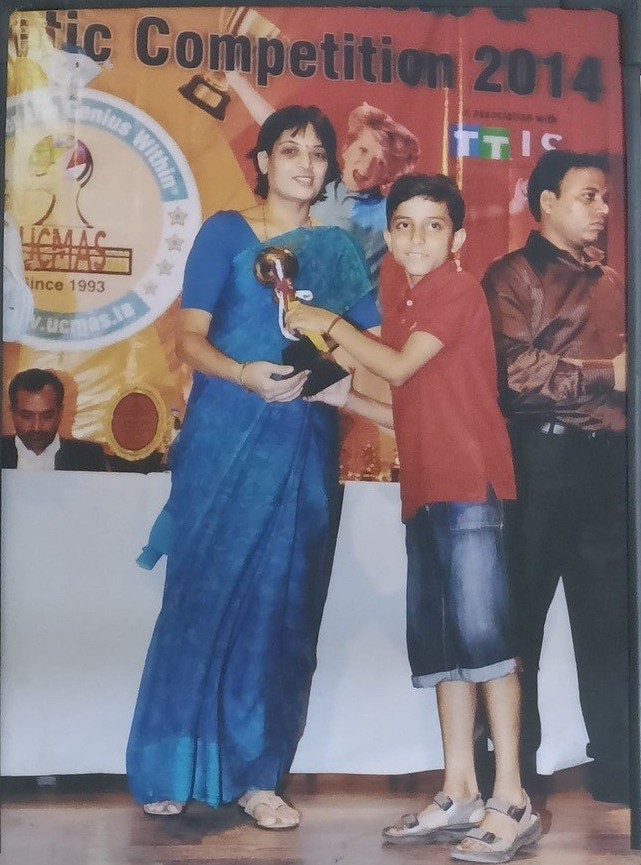
I have liked numbers for as long as I can remember. In 2014, I was runner-up in West Bengal at an abacus competition. That photo still sits in a frame.
Then school turned into a system I learned to beat. I cleared my exams, and from the outside everything looked fine: good report cards, pleased teachers, relaxed parents.
The truth was less impressive. Most of it was rote learning. I studied at the last minute, wrote the paper and moved on. I wasn’t learning. I was just getting through.
Ratta maarna aur seekhna, dono alag cheezein hain.
At the time, it didn’t feel like a problem. Everyone did it. I only noticed the difference when something finally made me curious.
A free period in 2019.
Class 10. A teacher was absent, so we had a free period. I spent it explaining to my friends what a stock is: a small piece of a company, why its price moves, and why people put their money into it.
One of them recorded it. I didn’t even know what CFA stood for back then.
“I was never bad at learning. I was bad at learning things I did not care about.”
That day, I realised that when a subject genuinely interests me, studying stops feeling like effort. Hours pass without my noticing. For me, learning has always been less about the classroom and more about curiosity.
Engineering, and markets.
Then I did what most families expect. I prepared for JEE and went on to study Electronics and Communication Engineering at VIT Vellore.
In college, most people were practising coding problems for placements. I was reading businesses: annual reports, earnings calls, bond yields. I kept building simple frameworks to understand how a company really works.
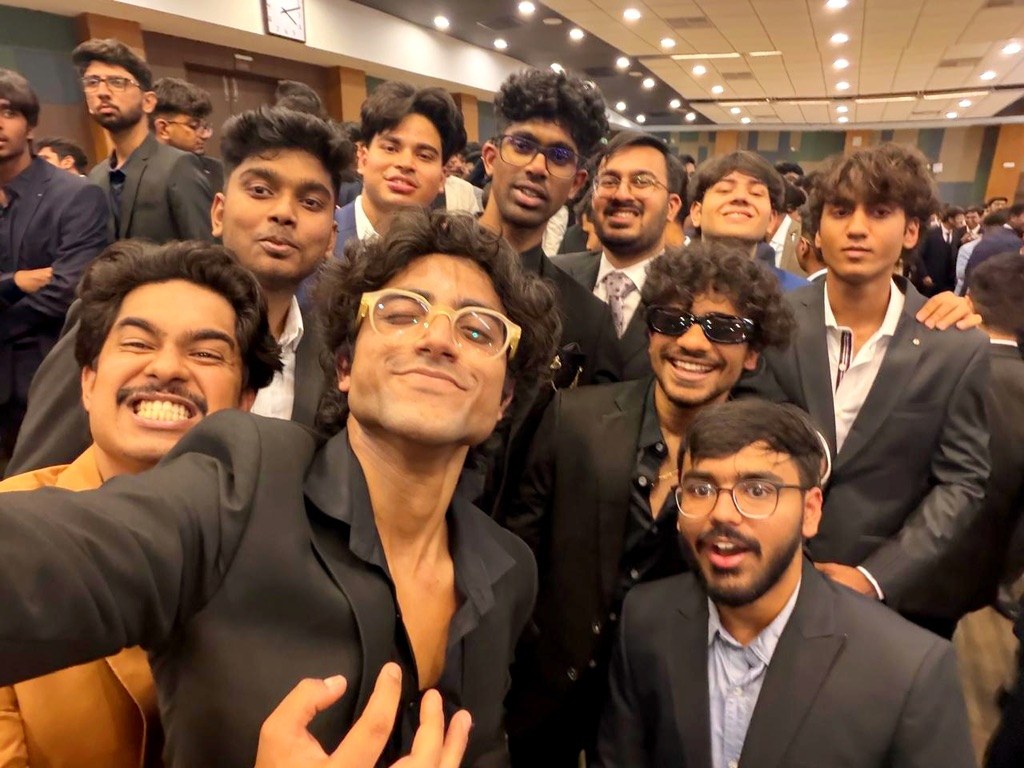
Two people shaped that path, and they deserve the credit. Ishmohit Arora sir taught me that research means going deep instead of stopping at the surface. Parth Verma gave me a line I still follow: gather as much information as you can.
Most of my classmates chose whichever job paid the most. There’s nothing wrong with that. My answer was simpler: do what I love. For me, that meant businesses, markets, money and how the world moves.
Safe choice aur right choice hamesha same nahi hoti.
The question every recruiter asks: CFA?
It comes up in almost every interview. I respect the CFA charter, and everyone who earns it.
But I’m not naturally an exam person. I learn best through the work itself: researching, talking to people, watching businesses closely, making mistakes and getting better.
I did take the exam that mattered. A research analyst in India needs the NISM Series XV certification, so I cleared it. Beyond that, my answer is simple.
People will judge the work, not the letters after my name.
Investace Capital.
At 22, I co-founded Investace Capital, a SEBI-registered research firm in Mumbai. We research listed Indian businesses, and you can see our work at investacecapital.com.
It’s where I learn by doing: how businesses are built, how they scale, where they break and where value actually comes from.
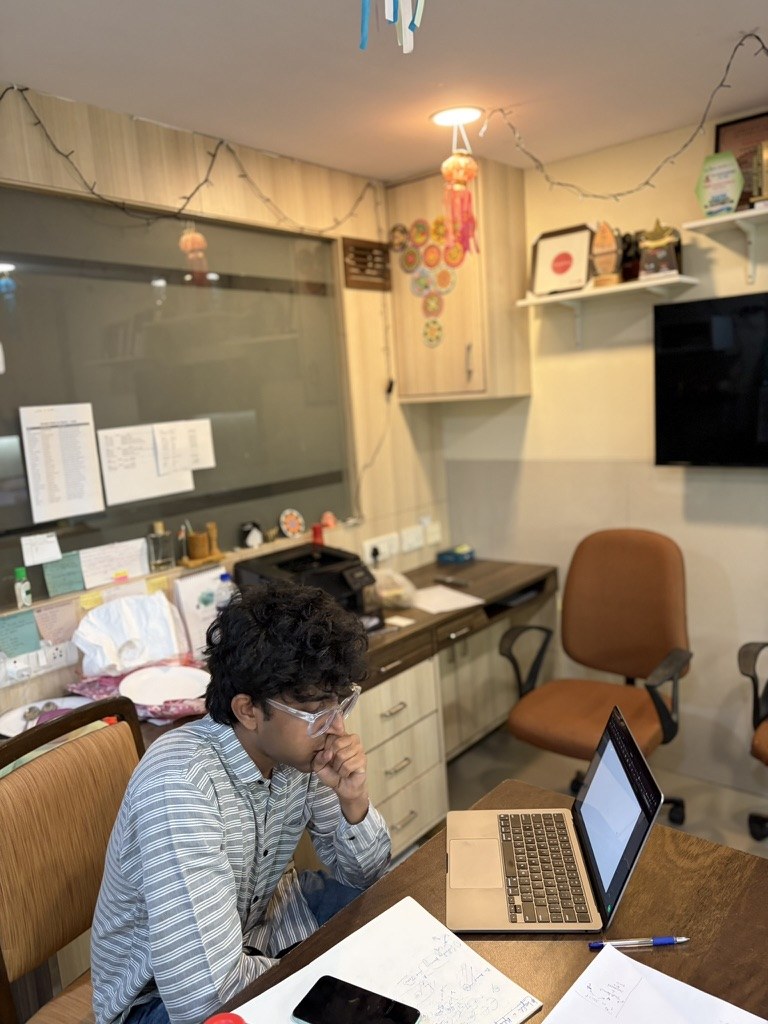
I’m building in public. Not because I have it all figured out, but because I want my thinking to compound in public.
How I think.
I think of it like a jigsaw puzzle. One piece on its own shows almost nothing. Put enough of them together and a picture starts to appear.
Here is a made-up example. A small town gets a new highway. In the same month, a company says it will open a factory nearby, the local bank starts advertising home loans, and land at the edge of town quietly gets more expensive. Each of these is a small story most people skip. Put together, they say the town is about to grow, long before anyone writes that headline.
That is the whole habit: keep collecting the small pieces, notice when they start to fit, and form a view before the news says it out loud.
Questions excite me more than answers. What is changing that nobody is talking about yet? Who gains if it carries on, and who quietly loses?
Next to every view, I write down what would prove me wrong.
Main certainty sell nahi kar raha. Main better thinking build kar raha hoon.
“I don’t want to sound certain. I want to become less wrong.”
A little personal.
I’m an introvert. I don’t talk much about my personal life, and small talk, parties for the sake of parties and endless gossip drain me.
I do enjoy meeting people. The conversations I value most are the ones where I learn something real: a business, a career, a market, a piece of history, or how someone built something. When someone is teaching me, I listen carefully.
And when a topic genuinely interests me, I can talk for hours. One example leads to the next, I go deep into the details, and sometimes I find it hard to stop. Business, economics, markets, geopolitics, history: yeh cheezein mujhe genuinely excite karti hain.
My past relationships taught me something about myself: I overcommit. When I’m emotionally invested, I make the other person the centre of my attention and lose my focus. That’s my pattern, not anyone else’s fault.
So for now, I’ve consciously stepped back from dating. Relationships aren’t bad, and I don’t have all the answers. I may be wrong about this too. But right now, I want to protect my focus, build my work and become more emotionally steady.
“Attention is expensive. Right now, I’d rather invest mine in becoming someone I respect.”
I’m also not comfortable on camera. People tell me to record more, that I look fine. Maybe. But I find it easier to put my thinking on the page than to put myself in front of a camera. That’s partly why the face on my home page is made of small pieces.
My version of Bunny’s book.
If you’ve watched Yeh Jawaani Hai Deewani, you know Bunny. He kept a book of every place he wanted to see before life slowed him down. I always admired that about him. He knew exactly what he wanted from his life, and he wrote it down.
“Main udna chahta hoon, Naina… daudna chahta hoon… girna bhi chahta hoon… bas rukna nahi chahta.”Bunny, Yeh Jawaani Hai Deewani
Every poster on my wall is a city I’ve promised myself: New York, Zurich, Tokyo, Queenstown, Oslo, Edinburgh. I look at them every day.
Beyond that, I don’t care much for things. Cars and bikes don’t excite me. The only place I happily spend money is tech, and I’m an Apple fan through and through. Everything else, I’d rather put into experiences and into work.
The vision.
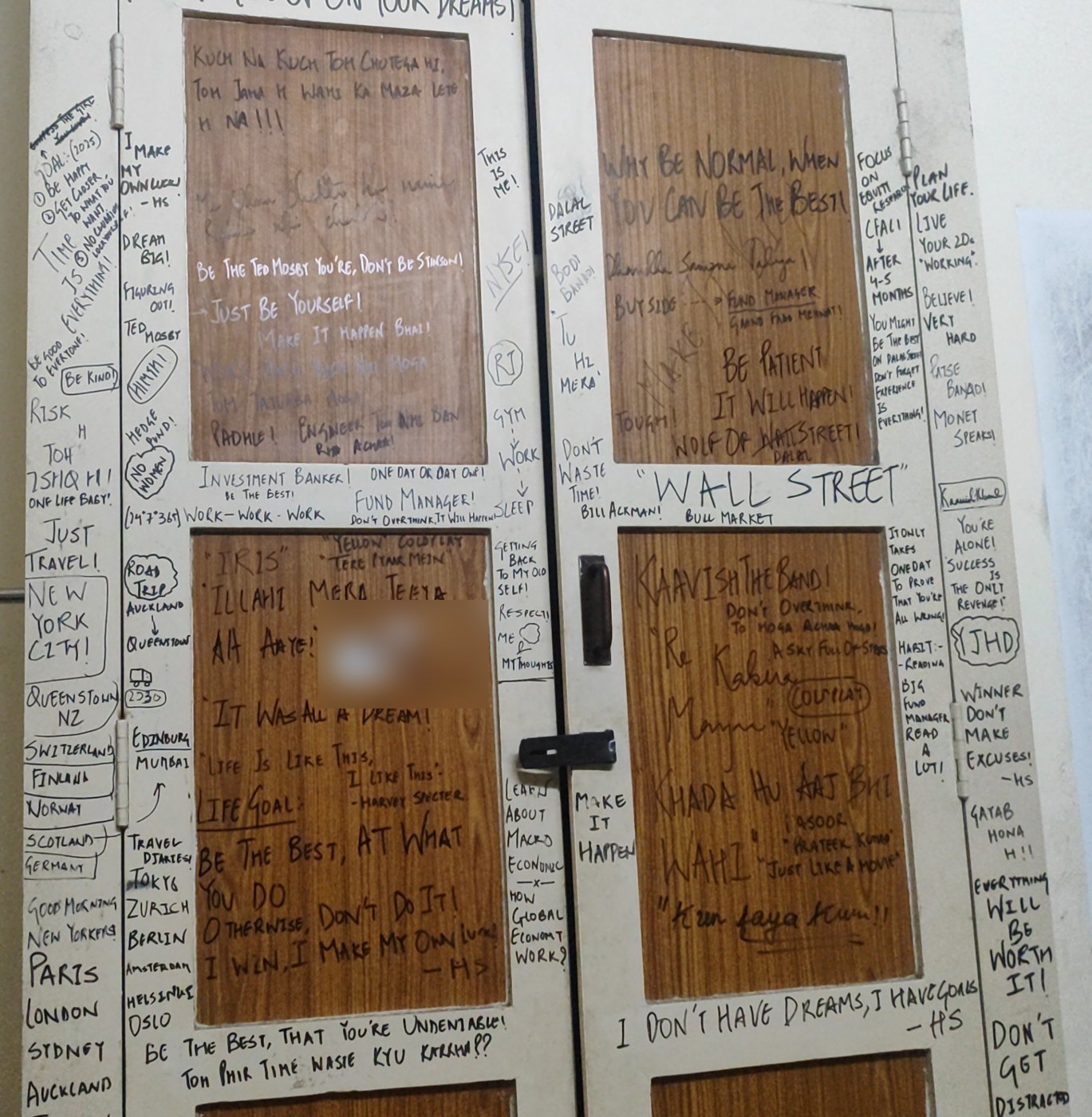
This was the wardrobe in my college hostel room. It was the first thing I saw every morning. The cities I want to see, the lines that kept me going, and markets written all over it: Dalal Street, Wall Street, fund manager. I was obsessed with something called markets. I still am.
The vision is simple. Good opportunities don’t only sit in listed companies. Some of the best ones are in businesses that haven’t listed yet. I want to find them in both places, in India and wherever else they are.
That is why the ultimate goal is to one day run a Category III AIF. Everything I’m building now, the research, the engines, the writing, is a step towards it.
This is a personal ambition, shared as part of my story. It is not an offer of any product or an invitation to invest.
Hope is a good thing.
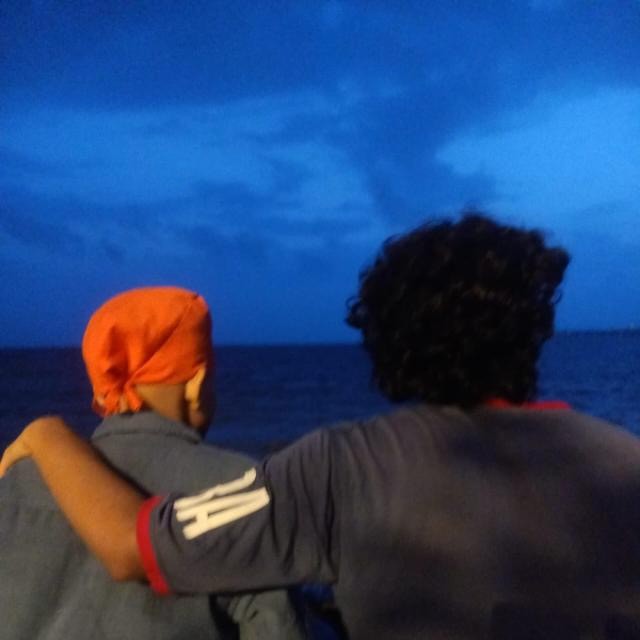
This year I made myself one commitment, and it didn’t come from work. It came from my brother.
In May 2025, he was diagnosed with cancer. Over the next year he went through 18 cycles of chemotherapy, surgery and radiation. A few weeks ago, the cancer came back. It was nobody’s fault, and somehow that makes it harder. There is no one to blame, and it makes you question everything.
His treatment is at Tata Memorial Hospital in Mumbai, one of the largest cancer centres in Asia. The first time I walked in, my mind went blank. So many people were struggling just to see a doctor, and so many couldn’t keep up with the costs, even with all the support the Tata group gives. I will always be grateful to them.
Then I walked into the paediatric oncology ward, and I couldn’t look for long. Those children should have been out playing. Their parents were carrying more worry than anyone should have to.
Inhone toh abhi zindagi dekhi bhi nahi.
That day I decided something. If I ever become capable enough, I will help children with cancer who need it, and the families who need someone to lean on. I know what that waiting feels like. I’m still in it.
When his treatment started last year, I had two months of summer break from college. Everyone around me was doing internships and getting pre-placement offers. I was sleeping at the hospital. I don’t remember a single day that summer when I didn’t go. I would sit near the reception with a newspaper and wait, often two hours, to see the doctor, and we were private patients. I kept thinking how much harder it must be for everyone else. My respect for doctors grew more than I can put into words.
In those corridors, every question comes to you. Why us? What did we do wrong? And you keep telling yourself there is a brighter side.
“Money doesn’t always buy happiness. Sometimes it buys time, and time is what you build happiness with.”
When the PET-CT report came back and the doctor told us the cancer had returned, one line from my favourite film, The Shawshank Redemption, kept playing in my head: “Remember, Red, hope is a good thing, maybe the best of things, and no good thing ever dies.”
What happens next is not in our hands. My brother is with some of the best doctors in India, and they will do everything they can to give him a good life for as long as possible. I remind myself of that every day.
These two years have been very hard on my family. But you don’t give up. Through all of it, I’m doing what I love, in the city I always wanted to live in, and getting a little better every day. If this website does one thing, I hope it reminds you never to lose hope.
If you’ve read this far, we probably think alike.
Join the newsletter. I’ll only write when I have something worth saying. Main figure out kar raha hoon. In public.